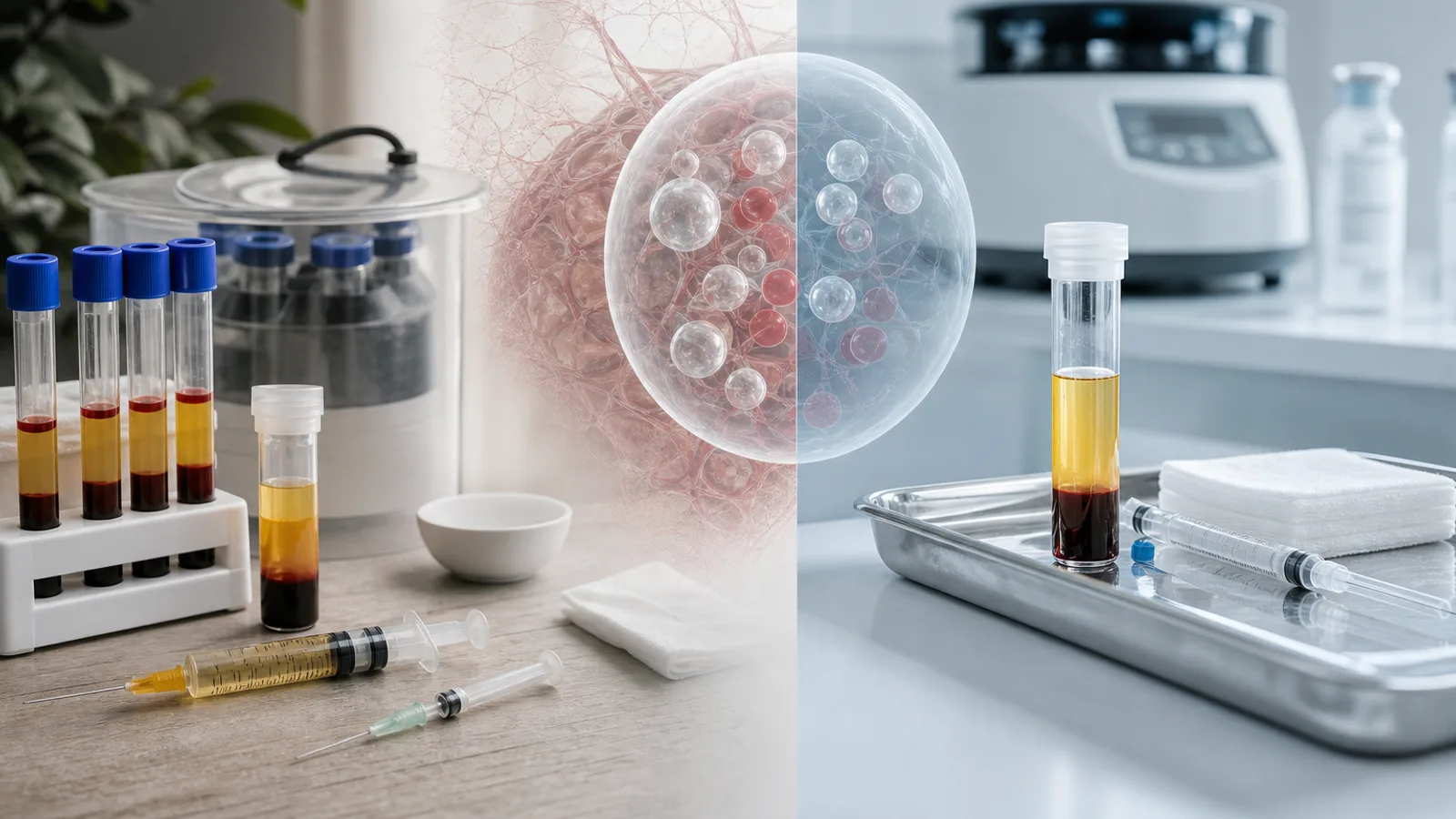
Thinking about doing your own platelet rich plasma (PRP) injections to save money or time can be tempting. This comparison walks through how DIY and professional PRP differ on safety, cost, results, and legal risk so you can make an informed decision in South Florida.
What actually changes when you move from DIY PRP to a medical clinic?
If you search online, you will find home centrifuges and PRP “kits” marketed directly to consumers. On the surface, the steps look straightforward: draw your blood, spin it down, and inject it back into a joint, scalp, or face. In reality, the research shows that a lot changes when you move from a do it yourself setup to a physician supervised procedure in a clinical environment.
A core difference is that PRP is a blood product and an injection treatment, so it combines the risks of both phlebotomy and minimally invasive procedures. A professional clinic is set up for sterile technique, safe sharps handling, and emergency response if something goes wrong. A DIY environment usually is not. In published reports of complications related to regenerative injections in the face, serious events like lymph node enlargement, immune reactions, and rare but devastating vision loss are associated with injections placed in or near high risk vascular zones by people who did not fully appreciate the anatomy involved.
Another major change is the level of quality control over the PRP itself. A recent systematic review of PRP across specialties found large differences in how PRP is prepared, even in research settings. Centrifuge settings, how many spins are used, whether the sample is activated, and final platelet concentration are often inconsistent. When you try to reproduce those steps in a home or spa environment without lab controls, the variability tends to increase, not decrease. That can mean your DIY PRP has far fewer platelets than you think, or in some cases concentrations outside the ranges researchers usually study.
- Clinical settings use sterile rooms and single use supplies for injections.
- Licensed professionals have specific training in anatomy and injection technique.
- Professional PRP protocols are documented and repeatable from visit to visit.
- Emergency equipment and medications are on hand if a reaction occurs.
How does safety differ between DIY PRP and professional injections?
From a safety perspective, PRP is not just “your own blood” and therefore automatically harmless. The case series and reviews on regenerative treatments in facial plastic surgery highlight that technique and anatomical knowledge matter a great deal. When PRP is injected into areas with complex blood vessel networks, such as near the glabella between the eyebrows or the temple, an accidental injection into a blood vessel can, in rare cases, cut off blood flow to the eye. The published literature includes cases of irreversible vision loss after injectable regenerative procedures in these zones.
Licensed clinicians are trained to minimize these risks by understanding three dimensional anatomy, avoiding specific danger zones, aspirating appropriately, and adjusting needle placement and depth to the area being treated. They also follow strict sterile procedures to reduce the chance of infection. In contrast, DIY approaches often happen in non medical rooms, with reusable surfaces and improvised disinfection. Even if you are very careful, it is difficult to match the infection control standards of a clinic, especially when handling blood products, needles, and centrifuges.
The systematic review of PRP preparation methods also points to safety concerns when platelet concentration and handling are not controlled. Inadequate platelet counts may simply reduce potential benefit, but contamination from poor handling or improper storage temperatures can increase the risk of infection or inflammatory reactions. Professional kits and lab protocols are designed to control these variables. When you remove those checks and rely on online instructions, you accept a higher personal risk that is hard to quantify before you start.
- Infection risk increases when you cannot maintain clinical level sterility.
- Anatomical errors in facial or joint injections can cause serious harm.
- Improper handling of blood products raises the chance of contamination.
- Professional follow up allows earlier detection of complications.
What does the research say about PRP quality control and why does it matter for DIY?
You might assume that spinning your own blood in a centrifuge will reliably concentrate platelets to a useful level. However, a recent systematic review of randomized trials using PRP in various specialties found that preparation methods and final platelet doses differed dramatically from one study to the next. Centrifugation speed, number of spins, leukocyte content, and use of activation methods were all over the map. The authors introduced a scoring system, WESS PQR, to describe and rate the quality of PRP preparation and reporting for research.
The takeaway for a potential DIY user is that even in controlled research settings, it is difficult to achieve standardized PRP without detailed protocols and equipment. Many mistakes that the review authors highlighted, such as not knowing the final platelet concentration, poor sterility, and uncertain storage conditions, are the same pitfalls that show up in informal or poorly supervised settings. If your home procedure produces a sample with a very low platelet count, you are essentially getting a saline like injection. If the concentration is far higher than ranges studied in clinical trials, the safety and efficacy profile is less clear because it has not been as thoroughly evaluated.
Professional clinics that focus on PRP build their protocols around consistency. They choose specific kits and centrifuge settings, document the expected platelet enrichment, and run the procedure the same way each session. They also draw and process blood under conditions that meet medical standards for sterility and documentation. This does not guarantee a particular outcome for any one patient, but it does reduce the uncertainty about what is actually being injected, compared with improvised at home attempts.
- PRP quality depends on centrifuge speed and duration.
- Final platelet counts are rarely known in DIY setups.
- Leukocyte content varies and can affect inflammation.
- Temperature and storage affect platelet function over time.
How do costs really compare between DIY PRP and professional injections in South Florida?
Cost is one of the main reasons people consider DIY PRP. Published surveys of orthobiologic pricing in the United States show that professional PRP injections are not inexpensive. One study of sports medicine practices reported an average price around 707 dollars per session, with a wide standard deviation and a range from roughly 175 dollars to nearly 5,000 dollars per injection. Another study looking at major orthopedic centers found per session prices between 350 dollars and 2,815 dollars, with a median close to 800 dollars.
South Florida clinics, including those in and around Lighthouse Point, generally fall somewhere within those national ranges, depending on the body area treated, whether ultrasound or other imaging is used, the type of facility, and the training of the person performing the injection. You can often find some room to save by comparing licensed providers and asking what is included in the quoted fee. Professional pricing reflects not only the time of the clinician but also the cost of certified PRP kits, sterile supplies, staff, imaging, and follow up visits.
A DIY setup may appear cheaper because you are not paying for professional time in the same way. However, when you add up a home centrifuge, single use needles, syringes, anticoagulant tubes, disposal containers, disinfectants, and replacement parts, the cost difference can narrow. More importantly, the financial risk profile shifts. If something goes wrong in a DIY environment and you need emergency care or treatment for an infection or complication, the total cost can quickly exceed the price of letting a trained team perform the procedure from the start.
- Published PRP prices range widely among U.S. clinics.
- Professional fees cover sterile supplies and equipment.
- DIY setups often underestimate recurring supply costs.
- Complication related care can be far more expensive than a single session.
What are the legal and practical issues of DIY PRP in Florida?
Beyond medical risk and cost, there is a legal dimension to DIY or informal PRP injections in Florida. State law treats activities like drawing blood, preparing biologic materials, and injecting them for therapeutic or cosmetic reasons as the practice of medicine. Florida Statutes section 456.065 specifies that unlicensed practice of a health care profession is illegal and can be prosecuted as a criminal offense. The Florida Department of Health operates an unlicensed activity program specifically to investigate and act on situations where injections or other medical services are provided by people without proper credentials.
For you as a patient, this means that arranging to have a friend, a technician without the right license, or a mobile operator perform PRP injections can expose both of you to legal trouble. It also removes many of the protections built into a regulated clinical relationship, such as formal informed consent, access to medical records, and avenues for complaint if something goes wrong. When you work with a licensed physician or other qualified prescriber, you can verify their license on state websites, understand who is supervising your care, and expect adherence to professional standards.
On the practical side, having a medical team involved also affects what happens after the injection. PRP is not a quick, one and done event. Many protocols in the literature involve series of treatments and follow up assessments. A clinician will usually outline a follow up plan, monitor for delayed reactions, and adjust your overall treatment strategy. In a DIY setting, you are responsible for recognizing complications, interpreting changes in symptoms, and deciding when to seek help. That can be stressful, especially if you are trying to recover from pain or a cosmetic concern at the same time.
- Florida law prohibits unlicensed individuals from performing medical injections.
- You can verify a provider’s Florida license through state resources.
- Licensed care offers clearer avenues for follow up and accountability.
- Informal arrangements shift legal and medical risk onto you personally.
When does it make sense to choose professional PRP over trying it yourself?
If you are weighing your options, it helps to clarify your priorities. If your main goal is to minimize upfront cost at all costs, DIY approaches can look appealing, but they ask you to accept increased medical and legal risk and more uncertainty about what you are actually receiving. If your goals include safety, consistent technique, and clear communication about benefits and limits, the professional route is more aligned with what the research and regulatory environment support.
In a medical clinic, PRP is evaluated in context. A physician or other qualified clinician will review your history, perform an examination, and determine whether PRP is appropriate compared with other options. They can explain what the evidence shows in your specific use case and set realistic expectations. They also have access to tools such as imaging guidance, which may improve placement accuracy for certain joint or tendon injections. If you are thinking about PRP in the face, the evidence around serious vascular complications strongly favors working with someone trained in detailed facial anatomy and injection safety.
If you decide that professional care is the right fit, you can ask specific questions before you commit. These might include how they prepare PRP, what their expected platelet enrichment is, how they maintain sterility, what follow up looks like, and how many sessions they might recommend. You can also ask about pricing in advance, bearing in mind the published ranges in the research, and discuss whether any imaging or add on services are included. At our clinic, PRP injections are provided under physician supervision, using standardized protocols aimed at safety and reproducibility rather than improvisation.
- undefined
- undefined
- undefined
- undefined
- undefined
- undefined
- undefined
- undefined
Frequently asked questions
- Is it safe to inject PRP yourself at home?
- Injecting PRP yourself at home is not considered safe by medical standards. Research on complications in regenerative injections shows risks such as infection, immune reactions, and, in facial areas, even permanent vision loss when injections are misplaced. Home settings rarely meet clinical sterility or provide the anatomical expertise needed to minimize these risks.
- How much does a professional PRP injection usually cost?
- Studies of U.S. clinics report that a single PRP injection can cost from about 175 dollars to nearly 5,000 dollars, with averages and medians in the several hundred to low thousand dollar range. One national survey found a mean price around 707 dollars per session, while another study at major orthopedic centers reported a range of 350 to 2,815 dollars with a median near 800 dollars. Actual prices in South Florida will vary by provider, body area, and whether imaging is used.
- Can a non doctor legally do PRP injections in Florida?
- In Florida, drawing blood, preparing PRP, and injecting it for therapeutic or cosmetic purposes are considered medical activities that generally require an appropriate license. Florida Statutes section 456.065 makes unlicensed practice of a health profession illegal and subject to enforcement by the Department of Health. Certain licensed non physician practitioners may perform injections under specific supervision arrangements, but unlicensed individuals are not permitted to offer PRP injections legally.
- Why does platelet concentration matter in PRP treatments?
- Platelet concentration is central to PRP because platelets carry growth factors and other bioactive molecules that researchers believe contribute to its effects. A 2024 systematic review showed that preparation methods and resulting platelet counts vary widely across studies, with inconsistent reporting. If the concentration is too low, you may not be getting much more than baseline blood plasma, and if it is outside the ranges that have been studied, the safety and benefit profile is less certain.
- What complications from PRP have been reported in the medical literature?
- Complications described in reports of regenerative injections, including PRP, range from mild issues like temporary pain or swelling to more serious events. In the facial region, there are documented cases of lymph node enlargement, immune mediated reactions, and rare but severe outcomes such as irreversible vision loss after injections in high risk vascular zones. These events underscore the importance of trained injectors, precise anatomical knowledge, and careful technique.
- How can I check if a PRP provider in South Florida is properly licensed?
- You can verify a provider’s license status through Florida’s official online license lookup, which is maintained by the state health authorities. By searching the provider’s name and profession, you can confirm that they hold an active license and see any disciplinary history that is publicly reported. This step helps you avoid unlicensed operators and supports safer decisions about where to receive PRP injections.
- Does DIY PRP save enough money to offset the extra risk?
- Research does not quantify DIY cost savings directly, but it does show that professional PRP sessions commonly cost several hundred to over a thousand dollars when performed in clinics and hospitals. While buying your own equipment may lower the apparent price per attempt, it also removes laboratory grade controls, sterility, and professional oversight. When you factor in the potential costs of complications and the uncertainty about PRP quality, many people find that the extra risk is not justified.