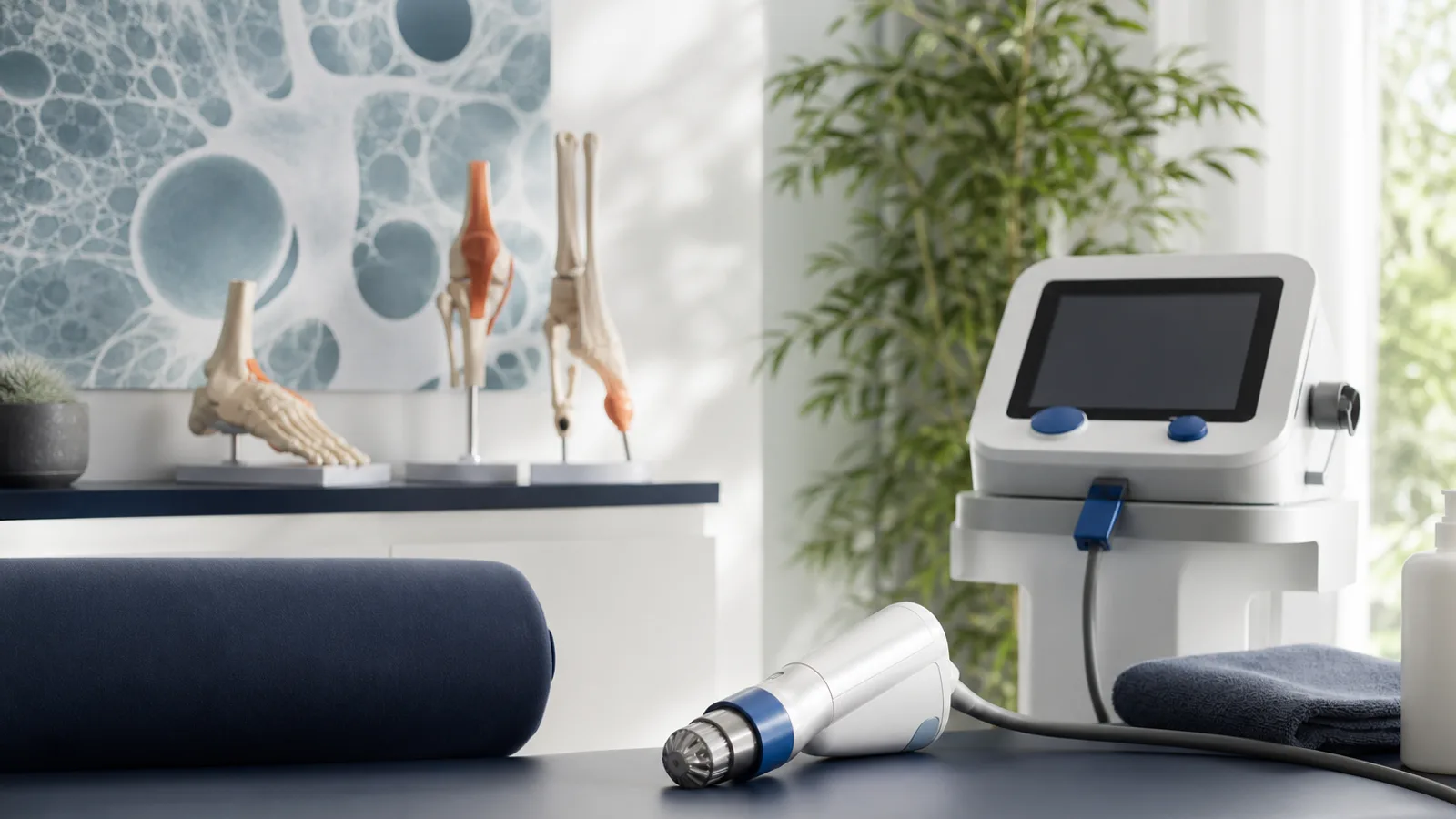
If you run and are dealing with stubborn tendon pain or a bone stress injury, shockwave therapy may be one option on the table. Here is how current research suggests runners can use it most effectively, and where its limits are.
What does shockwave therapy actually do for runners?
Extracorporeal shockwave therapy (ESWT) uses high‑energy acoustic waves delivered through the skin to targeted tissue. In musculoskeletal medicine, it is applied to tendons, fascia, and bone where there is chronic overload or delayed healing. The goal is to stimulate a local biological response that can reduce pain and support tissue remodeling over time. For runners, that typically means addressing problems like Achilles tendinopathy, plantar fasciitis, or bone stress injuries that have not responded well to simpler measures.
A 2024 systematic review of athletes and physically active people reported that ESWT, alone or in combination with exercise programs, was associated with improvement in several tendon and soft tissue problems that are common in runners. These included patellar and Achilles tendon pain, plantar fascia pain, medial tibial stress syndrome, and proximal hamstring tendinopathy. However, results varied by condition and protocol, and most studies still combined shockwave with other treatments rather than using it in isolation.
For bone stress injuries in runners, a 2023 case series using focused ESWT described improvements in healing and successful return to running when therapy was combined with imaging‑guided diagnosis, risk factor management, and structured load progression. That study highlighted that the technology is one component in a larger plan instead of a cure by itself. Across the literature and consensus guidelines, the theme is consistent: ESWT is a tool that may help shift a chronic, overloaded tissue toward recovery when applied in the right situation, but it does not replace training changes, nutrition, or strength work.
- Stimulates biological activity in overloaded tissue
- Targets tendons, fascia, and bone in chronic injuries
- Most evidence is in chronic, not acute, problems
- Works best when combined with rehab and load management
Which running injuries respond best to shockwave therapy?
The most consistent evidence for runners is in long‑standing tendon and fascia problems that have not improved with basic care. The 2024 review of 56 studies in athletes found supportive data for chronic patellar and Achilles tendinopathy, plantar fasciitis, medial tibial stress syndrome, and proximal hamstring tendinopathy. In these conditions, ESWT was usually added to an exercise‑based rehab program and sometimes outperformed comparison treatments or sham therapy in pain and function scores over follow‑up periods reported in the trials.
For plantar fasciitis in running and walking populations, ESWT has been studied extensively over the past two decades. Many trials show reduced pain and improved function over months, especially when symptoms have persisted for more than six months and other conservative measures have failed. Achilles and patellar tendons also feature prominently in the literature, and guidelines from international expert panels now list these as primary indications when symptoms are chronic and imaging supports the diagnosis.
Bone stress injuries in runners, including stress fractures and stress reactions, are a newer target for focused ESWT. In the 2023 runner‑specific series, moderate to high‑energy focused shockwave was used for imaging‑confirmed bone stress injuries, with at least three sessions given. Runners were screened for issues such as low bone density and relative energy deficiency, counseled on calcium and vitamin D, and taken through a graded return‑to‑run program. Many were able to resume running, but the data are from a relatively small, uncontrolled sample, so it should be interpreted as early evidence rather than definitive proof.
- Chronic plantar fascia pain lasting several months
- Chronic Achilles tendinopathy that has resisted basic care
- Patellar tendinopathy in jumping and running athletes
- Medial tibial stress syndrome and selected bone stress injuries
How should runners integrate shockwave with training and rehab?
Current research and consensus statements emphasize that the best use of ESWT in active people is alongside a structured rehab plan, not as a stand‑alone treatment. In the 2024 review of athletes, most studies allowed participants to keep training during shockwave therapy as long as their pain stayed within a manageable range and loading was adjusted. Exercise therapy, especially progressive strengthening and tendon‑loading exercises, was a core part of successful protocols for tendinopathy.
International sports medicine guidelines recommend that load management after ESWT should be individualized. For most tendon injuries without a high‑grade tear, experts agreed that full weight‑bearing is usually acceptable after treatments, as long as pain is monitored and progression is gradual. The best practice article in musculoskeletal medicine also notes that for older patients or those with partial tendon tears, particularly in the Achilles tendon, clinicians may recommend a more cautious activity plan in the first two weeks, because of limited data suggesting a potential increased risk of rupture with high‑energy focused shockwave in that period.
In practical terms for runners, the most effective programs tend to pair ESWT with clearly defined strength work, gait or technique coaching when appropriate, and a written return‑to‑run schedule that progresses distance and speed stepwise. For bone stress injuries, the 2023 case series shows that following a structured progression from cross‑training to walk‑run intervals to continuous running was an important part of recovery. The device session is one piece, but the way training is modified before, during, and after treatments appears to be just as important for the final outcome.
What does a high‑quality shockwave treatment plan include for runners?
Multiple guideline documents describe what should happen before, during, and after ESWT, especially in active populations. The International Society for Medical Shockwave Treatment states that a thorough clinical exam is needed, with imaging when appropriate and sometimes lab testing, before deciding that shockwave is suitable. It also recommends that focused ESWT be performed by a qualified physician with specific training in the technology and that the device type, focused or radial, be selected as a match for the tissue depth and condition.
The 2022 best‑practice article in musculoskeletal medicine adds practical details. It suggests starting with lower energy levels at the first session and then gradually increasing based on the runner's tolerance and the tissue response. It also highlights the importance of ergonomics and positioning for both the clinician and the patient, accurate documentation of settings used, and consistent probe contact to achieve the intended energy delivery. For older runners and those with confirmed partial tendon tears, the same article notes limited evidence that high‑energy focused treatments may temporarily increase the risk of tendon rupture, so clinicians often adjust energy levels and post‑treatment loading accordingly.
Post‑treatment, several sources agree on key medication and self‑care considerations. Nonsteroidal anti‑inflammatory drugs, such as ibuprofen, are generally discouraged immediately around the time of treatment, because they may interfere with the inflammatory signaling that is believed to be part of the beneficial response. Acetaminophen is often suggested as a safer option for short‑term pain control in guidelines. Ice application directly after treatment is also questioned in some best‑practice pieces, and many clinicians instead prioritize relative rest for 24 hours, then a planned re‑loading schedule. When all of these elements are coordinated, shockwave becomes part of a deliberate rehabilitation strategy rather than a passive procedure.
Where does shockwave therapy not work well for runners, or remain uncertain?
Even though the body of research on ESWT in athletes has grown significantly, there are still areas where it is not clearly helpful or where evidence is very limited. Many of the published studies focus on chronic, localized overuse problems that have lasted several months. There is far less evidence for using shockwave in very recent injuries, such as a calf strain from last week or an acute ankle sprain, and guidelines typically do not list those as primary indications. For these acute issues, standard early management and progressive rehab remain the usual path.
Not every chronic pain in a runner is a good match either. If pain is due to nerve irritation, systemic inflammatory disease, or a structural issue that requires surgical evaluation, ESWT is unlikely to address the underlying driver. The ISMST recommendations also list absolute and relative contraindications where shockwave should not be used, such as certain bleeding disorders, tumors in the treatment area, or pregnancy over the pelvis, which means some runners will not be candidates based on their overall medical picture.
In bone stress injuries, the 2023 runner series is encouraging but still early work, and it does not establish exactly which sites or severities of injury benefit most from focused ESWT. There is little high‑quality comparative data that tells us when shockwave clearly outperforms rest and graded loading alone for bone healing. Across tendons and bone, study protocols vary widely in energy settings, number of sessions, and combination therapies. That heterogeneity makes it difficult to predict for any individual runner how much improvement to expect or how quickly it might appear. This uncertainty is why careful evaluation, goal setting, and honest discussion about the role of ESWT is important before starting a plan.
How could shockwave therapy fit into your care at a South Florida clinic?
At a physician‑supervised regenerative medicine clinic, the aim is to integrate ESWT into a broader program tailored to your training level, injury history, and goals. A runner considering shockwave would typically start with a detailed history and exam, and, when indicated by guidelines, imaging to clarify the diagnosis. For bone stress injuries, best practice from the 2023 series also includes screening for nutrition, menstrual health in female athletes, and bone density, because these factors can strongly influence both injury risk and healing.
If your injury and overall health profile match conditions where shockwave is recommended by expert groups and supported by the athlete‑specific literature, a personalized treatment plan can then be designed. That plan can include session timing, energy progression based on your comfort and tissue response, coordination with physical therapy, and a written plan for adjusting mileage and intensity. For some runners, shockwave may be combined with other regenerative or rehabilitative options, depending on your case and the clinician’s judgment.
If you want to explore how shockwave therapy might fit with your current running injury and training, it is helpful to come prepared to discuss your mileage history, prior treatments, and upcoming race schedule. This allows the clinician to align the research‑based recommendations on shockwave with your real‑world demands and decide whether it is the right tool, a later‑stage option, or not appropriate for your specific situation.
- undefined
- undefined
- undefined
- undefined
- undefined
- undefined
- undefined
- undefined
Frequently asked questions
- Is shockwave therapy worth it for runners with chronic Achilles pain?
- Current research suggests that shockwave therapy can be helpful for chronic Achilles tendinopathy, especially when symptoms have persisted despite rest and standard rehab. A 2024 review of athletes found benefits when it was combined with structured exercise programs rather than used alone. It is not guaranteed to resolve symptoms, but it is considered an evidence‑supported option in persistent cases. A sports medicine clinician can help you decide if your specific tendon findings fit the studied group.
- Can I keep running while getting shockwave therapy?
- Many of the athlete studies included in the 2024 systematic review allowed participants to continue training as long as pain levels were manageable and loading was adjusted. International expert guidance also supports weight‑bearing after treatment for most tendon injuries without high‑grade tears. Your exact plan should be tailored to your injury, but complete rest is not always required, and thoughtful load management is often preferred.
- How many shockwave sessions do runners usually need?
- The number of sessions varies by condition and protocol, and research does not define a single best schedule. In a 2023 case series of runners with bone stress injuries, at least three focused shockwave sessions were used as part of a broader treatment plan. Tendon and fascia studies use a range of session counts. A clinician will typically base recommendations on the location, severity, and chronicity of your injury and how you respond over time.
- Is shockwave therapy safe for older runners or those with partial tendon tears?
- Guidelines and best‑practice articles note that ESWT is generally well tolerated, but they do advise caution with high‑energy focused treatments in older patients or those with partial tendon tears, especially in the Achilles tendon. Some limited data suggest a possible increased risk of rupture in the short period after high‑energy treatment in these groups. This does not rule out treatment, but it means energy settings and post‑treatment activity should be adjusted carefully under medical supervision.
- Does shockwave therapy help stress fractures in runners?
- A 2023 retrospective series of 40 runners reported improved healing and return to running when moderate to high‑energy focused shockwave was used for imaging‑confirmed bone stress injuries, combined with risk factor assessment and graded loading. However, this is early evidence without a control group, so it does not prove that shockwave is superior to conservative care alone. It may be considered as one part of a comprehensive plan for selected bone stress injuries after a full evaluation.
- What should I avoid before and after shockwave therapy for a running injury?
- Best‑practice guidance and expert recommendations typically advise avoiding NSAIDs around the time of treatment, since they could interfere with the inflammatory signaling that appears to be part of the desired response. Some protocols also recommend avoiding ice immediately after sessions and instead focusing on relative rest and then planned re‑loading. Strenuous new activities that overload the treated tissue right after a session are usually discouraged, and your clinician will outline specific activity limits where needed.